Norms and regulations
WEEE in Business: Who is Truly Responsible for End-of-Life IT Equipment?
Discover the legal obligations and best practices for responsible WEEE management.
Quentin
July 12, 2026

Discover the legal obligations and best practices for responsible WEEE management.
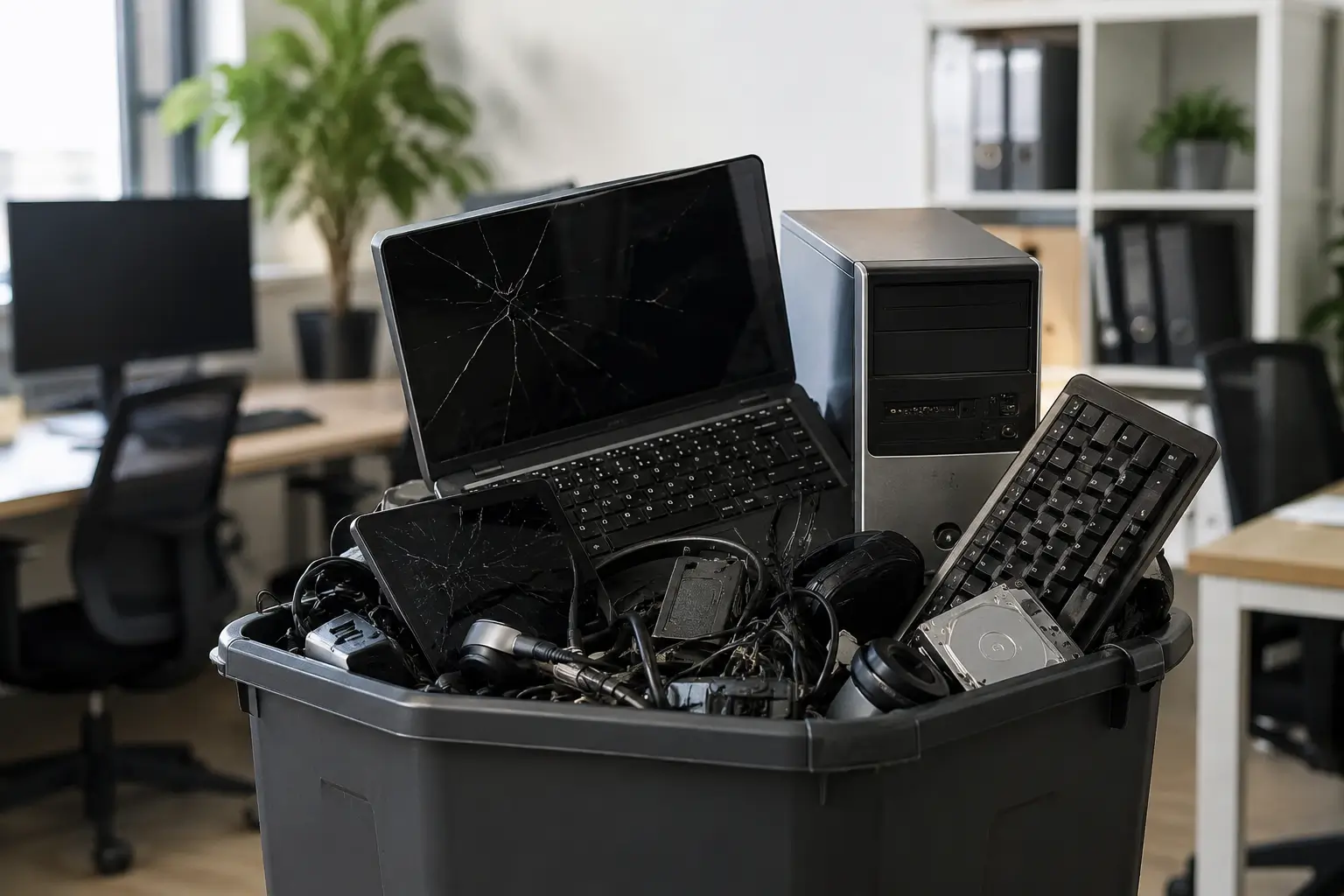
Every year, millions of computers, servers, screens, and smartphones reach the end of their life in French companies. However, their fate often remains unclear: who is responsible for collecting this equipment? Who finances its recycling? Who risks penalties for mismanagement? Waste Electrical and Electronic Equipment, the well-known WEEE, is governed by precise regulations, but these are still poorly understood by the professional world. Let's clarify the responsibilities of each stakeholder in the chain.
The French legal framework is based on a fundamental principle: Extended Producer Responsibility (EPR). Specifically, manufacturers and importers of electrical and electronic equipment (EEE) are legally obliged to finance and organize the collection, sorting, and treatment of waste generated by their products.
According to the Green IT Alliance, EEE producers are therefore the first link in the chain of responsibility. They must join an approved eco-organization or set up an approved individual system to ensure the management of end-of-life WEEE.
This mechanism aims to internalize the environmental cost from the product's design phase. In theory, this relieves user companies of part of the financial responsibility. In practice, however, it does not exempt them from their own obligations.
The User Company: Far From Being Out of the Game
While producers bear the financial responsibility for the sector, companies that use this equipment also have clear obligations. Regulations distinguish between two categories of users: households and professionals. For the latter, the rules are stricter.
As a company, you cannot simply dispose of your used IT equipment in regular bins. You must:
As highlighted in the Eco-responsible Digital Reference Manual from the Ministry of Ecological Transition, the end-of-life of digital equipment is not limited to its physical recycling: it involves a comprehensive reflection on traceability, data security, and the actual environmental impact of its processing.
Neglecting these obligations exposes companies to legal risks, as well as increasing reputational risks in a context where organizations' environmental responsibility is under ever-closer scrutiny.
In many companies, IT asset management is outsourced to specialized providers: managed service providers, maintenance companies, or leasing operators. These players have a key role in the WEEE responsibility chain, and their position needs to be clarified.
These providers can assume all or part of the end-of-life responsibility for equipment, depending on the contractual terms defined with their clients. This may include:
This is precisely where the model of the IT leasing makes perfect sense. By entrusting the management of the complete lifecycle of their equipment to an operator like Leasétic, companies ensure that end-of-life is anticipated from the moment the contract is signed, rather than being managed urgently when devices break down or become obsolete.
Leasing and the circular economy: turning challenges into opportunities
WEEE management is not just a regulatory obligation: it is also a strategic lever for companies committed to a corporate social and environmental responsibility (CSR) approach.
The end-of-life of IT equipment can be optimized through several complementary approaches: internal reuse, donation to charities, resale of refurbished equipment, or certified recycling through approved channels.
IT leasing naturally fits into this circular economy logic. At Leasétic, the end of contract is considered an integral part of the equipment's lifecycle:
This approach not only ensures compliance with regulations but also helps to reduce the carbon footprint of the IT infrastructure and maximize the residual value of equipment.
The issue of end-of-life IT equipment in businesses cannot be reduced to a single answer. It involves a chain of shared responsibilities : producers finance the sector, businesses ensure proper operational management, and IT service providers play an essential facilitating role.
In this context, choosing an IT leasing partner that integrates WEEE management into its offering is no longer a luxury: it's a strategic decision, both for regulatory compliance, data security, and the company's environmental commitment.
At Leasétic, we support organizations through every stage of their equipment's lifecycle, from acquisition to responsible end-of-life. Because sustainable technology starts with how you part with it.