Fleet management
Professional IT equipment rental: equipment, target users and how it works
Professional IT equipment rental: available equipment, target users and how it works at Leasetic.
Quentin
October 22, 2026

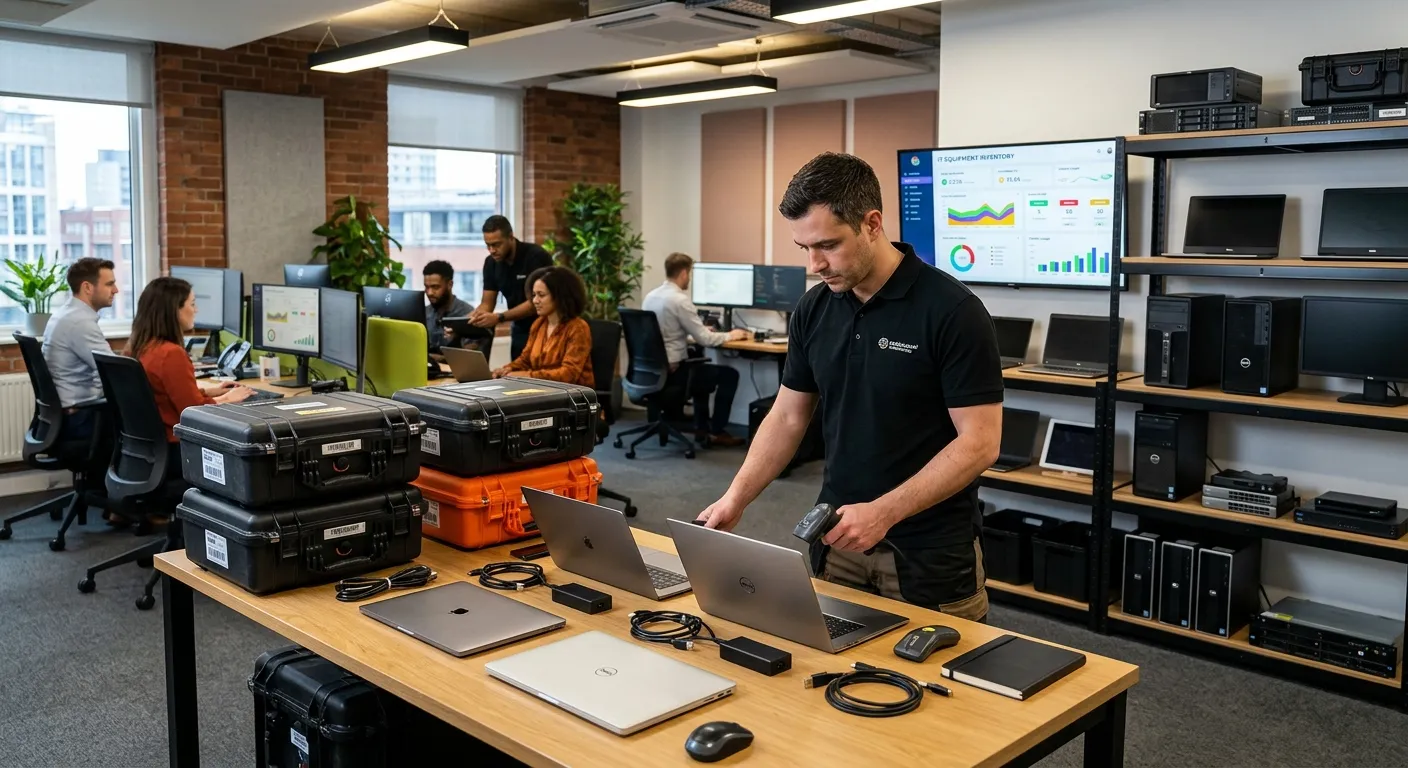
Professional IT equipment rental: available equipment, target users and how it works at Leasetic.
A service, not just a financing contract
Renting professional IT equipment is not just about choosing a financing option. It is also a very practical question: what equipment can be rented, for what uses, and how does the service work day to day? This guide outlines the scope of professional IT equipment rental at Leasetic.
Professional IT equipment rental covers a wider scope than is often thought:
As with leasing, the rent depends on the type of equipment, its condition (new or refurbished) and the term of the contract. Market ranges are generally between €15 and €40 per month for a standard workstation, and more for infrastructure (servers, network equipment) or specialised equipment. The equivalent purchase cost is generally between €800 and €1,500 per workstation, an amount that rental spreads over the term of the contract. These figures are indicative only: the best way to get an accurate price is an audit of your fleet and your actual uses.
This solution is aimed at very different profiles:
The process generally follows four steps:
Throughout the contract, the environmental impact of your fleet is measured device by device with Colibris.
Beyond the rent, well-managed rental makes it possible to track an indicator often overlooked by companies that own their fleet: the ownership rate, that is, the ratio between the number of devices owned and the number of actual users. According to Emmanuel Rousseau, founder of Leasetic, this rate averages between 1.3 and 1.5 in companies, mainly because employee arrivals and departures are not tracked precisely. Among Leasetic clients, it generally comes back down to 1.1, which means at least 20% savings in equipment, carbon emissions, raw materials and water not consumed.
This performance rests on a simple principle: at Leasetic, billing is synchronised with actual use, and the client only pays rent when the equipment is actually assigned to a user, which makes it possible to quickly identify duplicate equipment.
This management also fits into an increasingly structured regulatory framework for IT fleet management: the French AGEC law (fight against waste and planned obsolescence), the French REEN law (reducing the environmental footprint of digital technology), the repairability index, the non-financial performance statement (DPEF) and ESG criteria. From an accounting standpoint, rental contracts are subject to IFRS 16, which allows rental to be treated as an operating expense rather than an asset to be depreciated.
The Parera group, which specialises in land mapping (field scanners, drones), brought the financing of all its industrial equipment under a single contract with Leasetic. The contract volume grew from €70,000 to nearly ten times that amount, with annual operations of €700,000 to €1 million. Read the full case study.
SPIE, supported by Leasetic since 2019 with the financing and monitoring of around 13,000 workstations and 14,000 smartphones, illustrates the impact of managing by ownership rate: costs fell by 15%, and the ownership rate went from 130% to 115%. On the environmental side, 90% of the returned equipment was reused.
Can you rent just a few workstations, or do you need a full fleet?
Rental adapts to the size of your fleet, from a few dozen workstations for a growing SME with more than 50 employees to several hundred devices spread across several sites for a large account.
Does IT equipment rental include maintenance?
Technical support and maintenance are offered as an option, to be defined with you according to your needs and the type of equipment rented: it is not a service systematically included in the base rent.
Can new and refurbished equipment be combined in the same contract?
Yes. Equipment is chosen workstation by workstation according to use: new for the most demanding needs, refurbished through our partners for standard uses, within the same rental contract.
What is the delivery time for rented equipment?
It depends on the volume ordered and on the choice between new and refurbished. Refurbished equipment, sourced locally through our partners, is generally available faster than some new models facing supply shortages.
What happens if something breaks down during the contract?
Replacement of faulty equipment is covered when the technical support option has been included in the contract. We recommend defining it at signature with your Leasetic contact, so that you are covered with no unexpected extra cost in the event of a breakdown.
Is IT equipment rental tax-efficient?
Yes: rents are generally deductible as operating expenses, and rental does not weigh on the balance sheet the way a capitalised purchase would, a point to review with your accountant according to your situation.
Need to equip your company? Talk to our experts to define the option best suited to your equipment and your sector.
Further reading: discover the different business IT leasing options, our approach to circular IT financing, our criteria for choosing reliable refurbished equipment, how refurbished computer rental works, and the full interview with Emmanuel Rousseau on the advantages of renting IT equipment.